Diamond 4C
Four standards that describe value
A diamond is evaluated by the combination of its Color, Clarity, Carat and Cut.
Weight
Carat
Measures a diamond’s weight. Larger stones are rarer, but how big a stone looks depends on its cut.
Absence of color
Color
Graded from D to Z by how close the stone is to colorless. Generally, the closer to colorless, the rarer.
Inclusions and blemishes
Clarity
Classified from FL to I3 by the size, position and nature of internal and external characteristics.
Proportions and finish
Cut
Shows how well proportions, symmetry and polish bring out the diamond’s reflection and sparkle.
01 · Carat
Carat is weight, not size
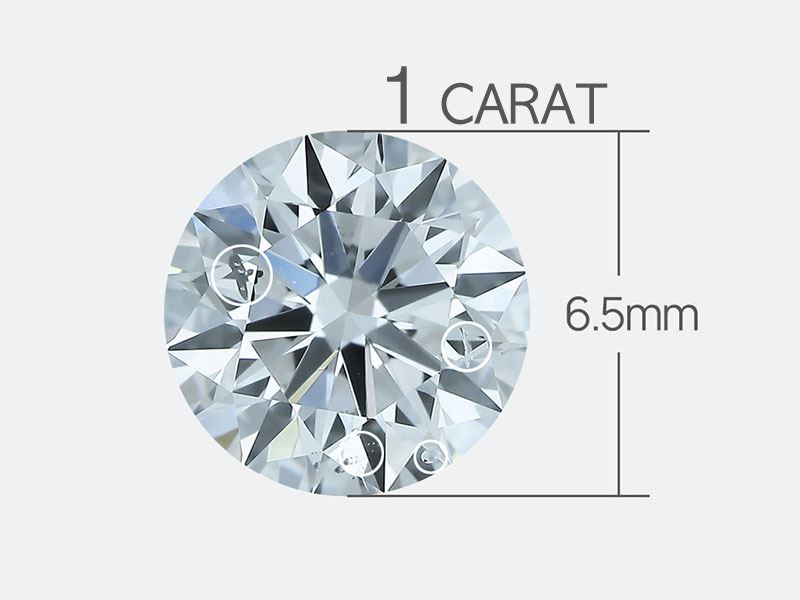
Carat is the unit used to weigh diamonds. Larger rough is rarer, so value climbs quickly with weight. But if the cut is too deep or poorly proportioned, a heavier diamond can actually look smaller.
For round brilliants, diameter gives a rough idea of weight, but always check the actual weight and measurements on the grading report.
About 3.0mm
0.1ct
A size often used for delicate accents and melee stones.
About 4.4mm
0.3ct
A good balance between everyday wear and presence.
About 5.0mm
0.5ct
Big enough to clearly enjoy a center stone’s brilliance.
About 5.5mm
0.7ct
Generous presence on a more restrained budget than 1 carat.
About 6.5mm
1.0ct
The classic benchmark where symbolism and rarity become distinct.
About 9.1mm
3.0ct
Far rarer than several smaller stones of the same total weight.
- Karat measures the purity of gold; carat measures the weight of a gem. They are different units.
- Small diamonds under 0.1 ct are called melee diamonds.
- Korean jewelers often read weights in bu (0.1 ct) and ri (0.01 ct), so 1.21 ct is read as 1 carat, 2 bu, 1 ri.
- Even at identical quality, 0.99 ct and 1.00 ct can differ significantly in price because of how rarity thresholds work.
02 · Color
The closer to colorless, the rarer
The GIA color scale runs from D to Z. Most natural diamonds have a faint yellow or brown tint, which makes near-colorless stones rarer.
After cut, color can have the biggest effect on how a diamond looks to the eye. Consider the metal it will be set in and the stone’s size to find the right balance for your budget.
Colorless
D–F
The colorless range, where even experts comparing side by side struggle to see any tint.
Near colorless
G–J
A popular choice for jewelry, balancing good value with a bright look.
Faint
K–M
A faint warmth may be visible; pairing with a yellow gold setting is worth considering.
Very light · Light
N–Z
Color becomes noticeable, so compare stones in person before choosing.
03 · Clarity
Clarity: every diamond’s fingerprint
Clarity is graded by examining internal inclusions and surface blemishes under magnification. What matters is not how many there are, but how their size, position, color and nature affect beauty and durability.
Two stones of the same grade can look quite different if one has a dark inclusion in the center and the other a small one near the edge. Check the actual video and the plot on the report together.
Flawless
FL–IF
An extremely rare range with no inclusions, or only surface features, visible at 10x magnification.
Very, very slightly included
VVS1–VVS2
Minute characteristics that even a skilled grader finds hard to see at 10x.
Very slightly included
VS1–VS2
Characteristics are visible under magnification, but many stones are eye-clean.
Slightly included
SI1–SI2
Characteristics are easier to see, so check each stone individually for eye-clean appearance.
Included
I1–I3
Visible characteristics can affect brilliance and durability, so choose with care.
- For an eye-clean stone, start with SI1 or better under 0.5 ct, and VS2 or better from 0.5 ct up.
- Large characteristics near the girdle or surface can affect durability if the stone takes a knock.
- External blemishes can be reduced by repolishing, but weigh the weight loss and change in value.
04 · Cut
Cut: designed to return light
Cut grading assesses how well a diamond’s proportions, symmetry and polish bring out brightness (white light), fire (flashes of color) and scintillation (sparkle as it moves).
A round brilliant usually has 57 or 58 facets designed to return light efficiently. Even a heavy stone can look small and dark if it is cut too deep, letting light leak out.
Excellent
Outstanding proportions and finish for abundant light.
Very Good
A sweet spot for beautiful visible sparkle and value.
Good
Some light loss is possible, so compare the actual sparkle.
Fair
Brightness and apparent size can vary widely with proportions.
Poor
Significant light leakage; may look smaller or darker than its weight suggests.
- A well-symmetrical round diamond can show a hearts-and-arrows pattern of eight arrows.
- If recutting is needed, weigh the improved cut against the value of the weight lost.
- Fancy shapes such as pear, oval, marquise and emerald often have no standardized cut grade, so checking real proportions and brilliance matters even more.